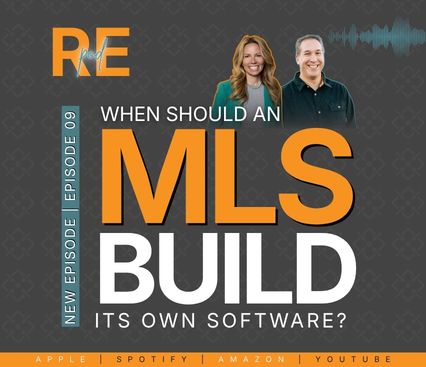
MLSs have more options than ever to build their own technology. The harder question is whether they should.
MLSs have more options than ever to build their own technology. The harder question is whether they should. As Brad Bjelke, CEO of UtahRealEstate.com, puts it, “we can’t be everything to everybody.” And in an industry where one software decision can affect data, vendors, workflows, and thousands of members, knowing where to build may matter just as much as knowing how.
On REpod, host Katie Smithson sits down with Brad to look at that question from someone who has lived both sides of it. Brad has worked as an MLS technology vendor, helped launch MLS Align, and now leads UtahRealEstate.com, where homegrown software is part of the operating model. His perspective is refreshingly practical: start with the problem, not the product.
That philosophy has produced everything from shared APIs and showing technology to a way for governments and researchers to access approved MLS data without being handed an MLS login. Some of those internal solutions stayed internal. Others became products that MLSs across the country now use.
But Brad is also wary of the idea that every MLS should become a software company. “People sometimes forget how deep the MLS is.” Building may be cheaper and faster today, but security, integrations, data dependencies, support, and member experience make the stakes much higher than simply shipping code.
Here are the key takeaways:
(1:28) Build, buy, or own the MLS product layer?
(5:18) Shared software gaps and the start of MLS Align
(6:48) The API push that moved MLS data beyond RETS
(8:24) Building showing software around an MLS need
(11:23) Controlled MLS data access for research and government
(13:21) Turning an internal solution into a vendor product
(15:04) Why MLS technology conversions are so hard
(17:19) The build-vs-buy rule: know your lane
(19:38) Easier data access, niche vendors, and AI tooling
(20:24) Consolidation, security, and who can safely build
(23:05) Solve the problem first, then choose build or buy
So where should MLSs own the technology? Where are vendors better equipped to fill the gap? And as easier data access creates room for smaller, more specialized real estate tools, could collaboration become more important than either building or buying alone? Tune in as Katie and Brad put that build, buy, or partner question to the test.
About Brad Bjelke
Brad Bjelke is CEO of UtahRealEstate.com, an MLS that builds much of its core technology in-house. His background spans both the vendor and MLS sides of real estate technology: he previously worked as an MLS technology vendor and served as VP and general counsel for CRMLS. Brad also helped with the creation of MLS Align, a collaboration among MLSs that has developed shared technology including API and showing solutions. His experience gives him a hands-on perspective on MLS software development, data access, build-versus-buy decisions, vendor relationships, and bringing internally developed products to other markets.
Connect with Brad:
About Katie Smithson
Katie Smithson is a long-time veteran of the real estate industry with a history of MLS relationship management and product innovation. In her most recent role, Katie was Chief Revenue Officer for California Regional MLS (CRMLS), directing revenue operations and ensuring proper communication and collaboration between all of CRMLS’s revenue-generating departments. In addition, she has also served as a NAR REACH mentor, board member for the Council of MLS with a CMLX 1 certification, and RESO Board Secretary.
Connect with Katie
Disclaimer
This podcast is for informational purposes only and features opinions, perspectives, and candid discussions about real estate technology and the broader industry. It is not intended as legal, financial, business, or other professional advice. Listeners should consult qualified professionals regarding their specific circumstances.
Listen to Other Streaming Platforms




Episode Transcript
Brad Bjelke 0:00
I think there’s too many MLSs that causes the data issues that we have experienced for the last 25 years. Building today is not just it’s easier and faster to build, but there’s also more security issues. There’s more risk of building bad programs than ever.
Katie Smithson 0:15
Why build it when it’s already there? Like there’s already a solution that works well. Is just make sure that these things work together. Should MLSs simply select technology from what is available out in the market, or should they help build and own more of that product layer themselves? Welcome to REpod, the organized real estate podcast for the industry by the industry. This is where MLS leaders, association executives, and brokers come to rethink operations, simplify complexity, and build systems that actually work together. Join the REcore team as we challenge outdated processes, explore smarter technology, and have honest conversations about the future of real estate. Let’s get into it. Hi, and welcome to another episode of REpod. I am your host, Katie Smithson, and today’s special guest is Brad Bjelke, CEO of UtahRealEstate.com. Brad, how are you doing today?
Brad Bjelke 1:15
I am doing well. Thank you for having me on your wonderful podcast. I’m looking forward to hopefully keeping people entertained.
Katie Smithson 1:23
I think we will have plenty of things to keep everybody entertained today. So, one thing I wanted to talk about today is just I think one of the larger strategic questions facing the MLS industry right now, which is, should MLSs simply select technology from what is available out in the market, or should they help build and own more of that product layer themselves? So, obviously, I wanted to have you on here to talk about this because you are not just an MLS executive that has built products, but you really helped with the creation of an entity that really put that idea into practice. So, I think just so everybody has a little bit of an understanding of your background. Obviously, I can summarize this real quick, and if you want to add anything to it, please feel free. But you’ve worked as an MLS technology vendor, served as VP and general counsel for CRMLS, one of the nation’s largest MLSs, and now you are leading Utah Real Estate, an MLS that has built and continues to build much of its own tech. So, pretty safe to say you are an expert in this arena, and my own personal note, probably one of the nicest humans I’ve ever met, so
Brad Bjelke 2:43
I appreciate that. Yeah, and you know that as the intro gets longer, then it makes you feel like you’re getting older too.
Katie Smithson 2:55
So I guess just to kind of start the conversation off, MLS aligned, and correct me if I was wrong. You formed MLSA line in 2018, right?
Brad Bjelke 3:04
Yeah, officially, I think we started talking about it in 2018. 2019 was when it came to fruition, kind of.
Katie Smithson 3:11
Okay.
Brad Bjelke 3:12
Yeah, yeah. And it was, you know, it’s the age-old question. I think what you asked is something that we I don’t think we struggle, but I think we address it every single day, you know. And that goes from everything from what we do internally at our company. You know, like how businesses run from HR to accounting to our software that we provide for people, is what’s out there. Like, what companies provide solutions to the issues and problems that we’re having, and is it better to utilize their services? Are they cost effective for what you get versus building the solution for exactly what you want? And so, I think, stems all the way from MLS software technology and what we provide to our customers, all the way down to the granular things that we do when we run a company, so we kind of address it every day and look for windows of opportunity to utilize our resources to build product that can fill the needs that we have. And so, going back to your Moss Line question, we kind of we you know, we looked at the environment that was out there back in 2019, and we said, what are things that are our problems, right? Like, where are there gaps in software, and is there anything that we can do? Not only ourselves, but is there something where we don’t want to overlap or reinvent the wheel if somebody’s already invented it? So it just led to discussions among a number of MLSs. So you know, when we started, we were talking. I think 10 or 15 people were in the room, and we talked about, is there ways to are there convenience things that we could utilize each other’s services for to solve some of these problems? So that’s how it started.
Katie Smithson 4:52
Yeah. So I guess, to just kind of add to that thought process, was there something in particular? Particular that was happening in that time frame that really brought you all together to say like here’s a particular thing we need to look at, or was it just, again let’s think about this let’s look at our internal processes, look at what we’re providing to our members, and it just kind of evolves from there
Brad Bjelke 5:18
yeah I think it was more general I think the discussion was, you know, some people were doing some tax software, some people were doing some statistics software, and you know, at that time there was a lack of APIs. Right, we were still in the RETS environment, and Utah was toying around with our own API, and we said, you know, maybe this is something that others could use, and so we just got in a room and said, “Here’s products that we’re using. Is there a need in your MLSs for these things? Is there places where we can bring our resources together to possibly build things? And it really was more general. It wasn’t centered around a certain product or a certain need. It was, “Is there a need for people to work together more so that we’re not wasting resources and time? And so that’s how it started. Started in a hallway with Jim Harrison and Matt Consalvo and myself, and I’m not going to say everybody, but we had a huge group of people that, like flew down to. I think we were in Arizona and kind of just talked about like, what could we do, what could we build, and from there it morphed into sort of the group that actually put in the time, money, and effort to start MLS Align, which is five MLSs: Utah Real Estate, Arizona Metro MLS in Milwaukee, RMLS in Oregon, and MLS listings in the Bay Area.
Katie Smithson 6:36
Yeah, I remember back then seeing some before MLS line was announced seeing some cryptic posts on Facebook. Sure, I was very curious as to what was going on.
Brad Bjelke 6:48
And our first project really was an API. We really tried to build an API that everybody could use, and that API is still in use today. We’re all using it, and it delivers data like efficiently and quickly, and vendors from all over the country are using it, whether they know it or they don’t know it.
Katie Smithson 7:05
Yeah, that’s pretty awesome. I remember WNR Studios, we when we got your API, it worked very well. So yeah, it was one. I mean, developers are always very happy with that.
Brad Bjelke 7:16
and we kind of always we kind of always talk about it. You know, you have to push the, you have to push the limit a little bit. Like we were, I think we were first to say, you know what, we’re not using ruts anymore. We’re only going to use the API, and you have to do that to drive vendors to make that move. And I think in the long run, it benefited everybody. I don’t know who’s not using one now, but I think data is delivered a lot more efficiently today than it was in 2018. Yeah,
Katie Smithson 7:42
We don’t have to send each other FTP files or anything. I know, right? Yeah, it’s great. So
Brad Bjelke 7:49
true. Yeah, so that’s how it came about, and then it morphed from there, and you know,
Katie Smithson 7:54
And then early on, you MLS Online acquired Agent Inbox, right? Wasn’t that one of the early acquisitions? And then, if you can again correct me if I’m wrong, but you kind of took that idea and morphed that into what you now provide as aligned showings. Is that yeah premise of how that all worked? Okay,
Brad Bjelke 8:17
Kind of. I mean, I think what happened was
Katie Smithson 8:20
I’m probably taking a shortcut in the
Brad Bjelke 8:21
no, it’s great. Yeah, no, it’s great. I mean, I think you know where it came about was you know we we saw a need. Certain people needed showing software. We knew it was a critical component of MLS services, right? There was a few vendors out there, and we thought you know maybe we can you know put a team together and build a piece of software that we all can invest in, and maybe it would be a great solution to some of the problems that we had with showings. And so, we started slowly, and we looked at the agent inbox messaging service, basically from what it really was back in the day. And you know, the agent inbox was the kickoff point for just a later build of technology that incorporated showings, and that product over time has just matured, and you know it’s now being used by I think we’re closing in on about 150 thousand users, which is exciting.
Katie Smithson 9:13
I was gonna say you’ve gotten a lot of new users, and it’s not just the partners that are part of MLS Aligned either you’ve really expanded out beyond that, so I think that’s that kind of segues into what I want to talk about next is just like the build versus buy partner, you know that whole question, and I think it comes up more and more these days. Obviously, like at Recore, part of the premise of CRMLS creating REcore was to kind of take the same concept that you had. The CRMLS evaluated products that they were using internally, and it was like, not really designed for the MLS industry. So I guess, to kind of take just the showing piece. A little step further, you know, what other offerings do you have out there? Or you can, I mean, if you can talk about like what you’re considering putting out there, anything that you want to share on that front, and then just a little bit why you decided to go down the path of, you know, where you want to go with the products and offerings that you have.
Brad Bjelke 10:22
Yeah, our shareholders actually are have been talking about this for years. They love our our MLS software. We are homegrown software, so we build it ourselves, and it’s modern and fun to use, and and and super easy, and has great features. And they’ve always said it would be great if you could you could build this product to license out for others and and create a diverse revenue stream for the organization, and you know when we looked at it years ago, you know it’s one of those things as as you know software evolves, but sometimes it’s it’s written so custom and so just written in a way where it served the need originally and didn’t didn’t lend itself well to being opened up, and so in the last few years we’ve spent some time like, hey, we can actually make this product available for others. It’s going to take some effort on our end, and we’re going to have to put in the time and the money and use the resources, and we sort of explored it, and we, you know, we have our own mobile applications. We said we could use those for other MLSs as well, and so we created a new company called Real Estate Data Technologies LLC, and we around that company we put our product lines into that, which is an MLS software, a mobile application software, a website software, and a product that we originally sort of launched called RE Data Export, which is built for serve a need in Utah. Really, first was we had government agencies that wanted MLS data. They either wanted it for public studies on housing, looking at low-income housing, housing affordability, and they wanted MLS data. And we had economists from the University of Utah who wanted data for some of their studies and reports, and we didn’t want to just give them a login to the MLS. And what was happening every year is was our staff was having to take all this time to create the reports and create the statistics for them. And so we said, what if we built something really simple that we could license out that would give non-realtors, basically non-MLS members, the ability to access certain fields that we allow through data licensing, and allow them to run the raw data out so they can build their reports. It keeps the data secure, safe, doesn’t give access to fields that non-members shouldn’t see, and it’s a huge community service, right? It allows some of the data to get out there in the media and to the governor’s office, and it’s been a huge hit for us. And so, when we built that, as we were building, we were like, people, other people might want to use this. And so,
Katie Smithson 12:55
I was just gonna say, like, this is yeah. I know there’s huge use case for this right now. That’s that’s awesome.
Brad Bjelke 13:02
And so…
Brad Bjelke 13:21
We have a bunch of customers using it, and wish we were one later on this because we just signed one today. That’s a big MLS who, we’ll probably put out a PR on. But it serves a need. It’s a very niche segment, but it serves a need. I think around the country. I think long term, every MLS or most MLSs are going to have a need for something like that, and so we just saw the issue. We knew there was a solution. The solution was time resources. You can run these reports, or you can give people access. But what if we created something real easy? And that’s what we did. And that was project number one. And and we’ve from there, we’ve now licensed our MLS out for the first time to the New Mexico MLS. Launched that in July, and that was a huge, huge thing. That was the first time we’ve really served as a vendor, and and our REcore now is a vendor right to MLSs, and so it’s fun and interesting times. And I think, you know, if you can do it right, I think there’s definitely a market, but also some opportunities to find some of the issues that are out there and solve them for basically for people that do exactly what we do all across the country.
Katie Smithson 14:32
Yeah, Well, I mean, congratulations on the new contract. We’ll keep an eye out for it. Yeah, yeah, yeah. And congratulations on the success in New Mexico. I mean, that’s a conversion is never easy, and I know you, and I talked a little bit about this offline. That, like, all things considered, it went very smooth, and that’s. I mean, when you don’t have the membership like at the MLS office, like with Pitchfork. And whatnot-that’s always a good thing after a.
Brad Bjelke 15:03
It’s a good thing, and any kind of technology change is hard. You know, I mean, moving from a Mac to a PC, you know, anything that you do can be super difficult. And so, one of the things I think MLSs can do is you can relate, right? I think our customer support can relate, our staff can relate, and and we try to find the it come out comes at it from a different angle, right? We try to find the issues that we know could be an issue, right, and anticipate them and solve those problems. And so I think there’s something to that, and I think long term we don’t want to be a large vendor, right? I don’t think the intent right now is to like, have a lot of customers, have a small group of customers that we can service well, and yeah, because otherwise, you know, the more customers have the same issues of what people are complaining about and have issues with, and you become part of that problem. Yep,
Katie Smithson 15:54
yep, for sure. Yeah,
Brad Bjelke 15:56
So it’s an interesting time, and I think I think technology lends itself right now. You probably know this. It lends itself more right now to being able to be things can be built faster with more security and better scale than ever before, and that is the reason why we can can enter a space. I think it’s things have just gotten a little bit more cost. It’s just not as costly to do some of these projects.
Katie Smithson 16:23
Yeah, and it can be really fun too. I mean, it’s it’s part of like part of discovering like how you can make everyone’s lives a little bit easier. Like what some of the things that you see in existing technology that maybe you want to tweak a little bit. So, yeah, I think it’s it’s really a fun time to be in in technology as a whole. Now, on that note of actually building your own technology, now you also license some technology both at Utah Real Estate and obviously, I know like some of the others in MLS align. It’s not like they have gotten away from traditional vendors all altogether. So I guess in your opinion, how do you determine what you want to build versus what you just, you know, it’s already out there we’ll just buy it or license it or whatever the case might be. What is just like big picture? How does that kind of factor in to your decision? I think
Brad Bjelke 17:19
It’s a mix because I think we can’t be everything to everybody, and I think people forget sometimes how deep the MLS is. You know, from, you know, it’s not just search and listing input; it’s all the reporting, the displays, the statistics. It’s so many things, and for so many people, and so many people use such different parts of the system that you kind of need this full system, right? And we all know that. And so, what we don’t want to do is leave our lane. Like our lane, we do search reports and listing input amazingly well, and we look at pretty much everything outside of that. If there’s a really awesome product that’s a CMA product, we’re going to look at it. If there’s a grade six product, we’re going to look at it, and we’re going to try to stay in our lane on what we do really well, which is the core. I feel like it’s the core component of the MLS. Not that the other things are not core components, but I think they’re they also just they’re deep products that have a lot to them, and it’s hard to be good at all of them. And so, yeah, we want to use companies that have great products that fill the gaps, and so we don’t have to develop things that we’re not really, honestly, that we’re not. It’s not in our wheelhouse.
Katie Smithson 18:31
Yeah, no, I think
Brad Bjelke 18:34
lots of vendor help. I mean, that’s, and we want vendor help. We also don’t want to be an island where we develop everything because I don’t think we would do as well.
Katie Smithson 18:43
Yeah, yeah. No, I think that’s extremely smart. I mean, I know like, I think there’s always this mentality in software development, and when you’re looking at even when you have something built and, like, maybe there’s another piece, another component that needs to be added in that maybe exists somewhere else. I think a lot of times the mentality is like, well, we can just build it ourselves. But sometimes it’s like, well, why build it when it’s already there? It all work like there’s already a solution that works well. Is just make sure that these things work together. So, I think on that note, what do you see in the future for MLSs and technology, and how everybody works together, do you think that there’s going to be more vendors that come into play? Do you think there are going to be more MLSs that are out there building their own technology, or a combination of both?
Brad Bjelke 19:38
That’s a good question. I’m not 100% sure where it’s going to go, but I do think as sort of the data access points get easier, whether that be through an MCP server to facilitate some AI development, or just even in the regular API feeds, I think there are more opportunities for companies to come in with very narrowly tailored products that. Can be very successful in this industry, and maybe they’re not MLS licensed products. Maybe they’re just partner products. They’re inside of a store or something. But I think, I do think that’s only going to increase because I think there’s a need for differentiation, and there’s a lot of problems and issues that realtors have that can still be solved through great software, so I think, that’s still going to happen. You know, I’m always a big proponent of consolidation. I think there’s too many MLSs that causes the data issues that we have experienced for the last 25 years. That hasn’t gone. I mean, it’s gotten better, but it hasn’t gone away, and we’re still struggling with that. So I think until that pain point is ultimately solved, which, you know, I mean, we’ve made great progress. When you think we’ve gone from over 1000 MLSs to around under 500, you know, but it has taken 25 years. Exactly. I mean, maybe that’s a maybe that’s a win and a success story, and maybe it’s not. I don’t know. I do think, and I think really the only MLSs that can truly build, I really believe this. You have to have the right resources. Building today is not just it’s easier and faster to build, but there’s also more security issues. There’s more risk of building bad programs than ever, and I think you have to have sophistication, like really good experience resources, not because others can’t build it, but because there’s so much more to it. When you’re connecting data and connecting pieces of the puzzle, you do it wrong, you can bring down a lot of different systems, which just leads to member dissatisfaction.
Katie Smithson 21:36
Definitely, yeah. I mean, these days I fancy myself a developer because I can get on Cloud Code and like try my own little projects, but I’m not building anything for the real estate industry.
Brad Bjelke 21:49
Yeah, I mean it’s, and that’s what I think is people are solving their own problems, and our data is going to help them solve problems on these little applications. So I do think that there’s probably going to be more vendors than ever, and they may be, they may be localized. They may be super small, and they could be big and go nationwide. But I think, like, you get the data, you can create certain code, you can do things you’ve never done before, and those problems get that get solved even if it’s at maybe one office level, right? Like, one office determines they have this issue, and they build their own code, and they solve it. So those things weren’t there before. It cost used to cost a lot of money, and now things are just a little bit cheaper.
Katie Smithson 22:28
Yeah, yeah. Well, this has been great. I have one final question for you. Yeah. In the time that you have been working with the MLS aligned group and really taking developing your software and taking it to the market. What lessons or words of advice do you have for any MLSs out there considering trying to build their own software or maybe already doing it? And then just generally to the industry, what can we do better as a whole, as far as innovation is concerned?
Brad Bjelke 23:05
I okay, that’s a great question. I think one of the best things that an MLS can do, regardless of your size on this, is if you have an issue, if you have a problem, come up with a way to solve it. Right, whether that is working with another vendor that’s out there that has a product or building it yourself. I mean, I think you have to look at the costs. I’ll give you a quick example. We just like every company have expense reports, and you have all these things that work with accounting, and all these companies out there who will, you know, give you credit cards and have you pay expensive fees for their expense report software, and it’s so robust and so huge, and most companies only need you know 1% of it, and so we just said, you know what? What if we just built our own expense reporting routing software internally? And so we spent, you know three weeks developing the code and built our own expense software, expense reporting software. Okay, so that fills the gap. I’m not licensing that out to anybody. That oh
Katie Smithson 23:58
Oh, I was gonna say, can you talk to Art
Brad Bjelke 24:02
But we built exactly what my accounting team wanted and needed, and it pulls the report directly into QuickBooks, and we populated all our vendors, super easy. And it’s a small project, and long-term, it saves like four people at the company a ton of time, and it makes their life easier. So there’s those projects, and then there’s the bigger projects, right? Which is, you know, how do we better serve our brokers and our agents across the country? And those bring up problems that are not technology-related, as you know. They are politically sort of those are the political problems that we still have today. And what I would encourage people is just to talk. I mean, MLS Alliance started by competing MLSs, really just talking with one another and seeing if there were some solutions for problems that we know cover markets all across the country. And so that’s where I would start: is that you know, if there’s a good piece of software out there, you should be open to looking at it and giving it a fair shake. And it doesn’t matter who’s behind it or who’s in. It’s software that fills a gap. If it’s going to make your members better, then you should be looking at it. We try to approach that every day as well. And I don’t know how many more will innovate. I mean, there’s probably about, you know, 20 or less MLSs that do it and they do it well. And hopefully, my hope is that they get bigger and have more resources to do better because they do it well now and would only do better if they were better capitalized.
Katie Smithson 25:30
Yeah, well, and hopefully we can all like work together better. Yeah, you know, like fill in those gaps together. That would be a bright, shiny new future. That’s my optimistic view of that. I mean, I think you
Brad Bjelke 25:44
You know what our REcore is doing. You know, there’s a few of us out there that have products and services that I think solve big problems, and you’re seeing the momentum go. I think it’s moving faster than consolidation, so that’s a good thing. You know, so yeah,
Katie Smithson 25:57
That is true. Yeah, maybe the innovation will help move along the consultation.
Brad Bjelke 26:03
Yes, yes, I hope so. But yeah, I I just appreciate you and you know your work in this industry. You have a thumbprint on lots of things that we all use, and it’s it’s pretty pretty amazing when I get to talk to people who know how to solve the problems and build good things. It’s fun. So I just think there should be more dialog like this.
Katie Smithson 26:23
Yeah, love it. Well, I appreciate you coming on today and sharing all your wisdom with us. This has been so great. And yeah, Brad, we will put your contact information, if that’s okay with you, in the show notes, so anybody can reach out to you, learn more about aligned showing, and I mean, if they want to talk to you about an MLS system, I guess we’re open to that too. All right, perfect. Okay, thanks, Katie. Thank you, Brad.
Brad Bjelke 26:50
Bye bye.