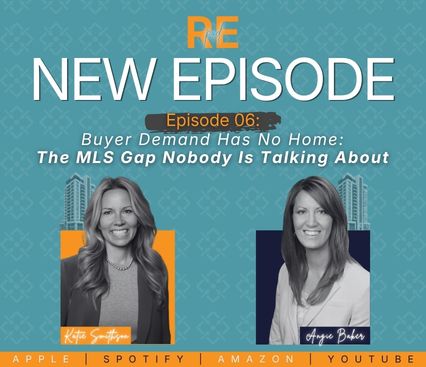
Here is a confession you do not expect to hear from the person running an MLS.
Angie Baker is Vice President of MIBOR’s Broker Listing Cooperative, and she will tell you flat out that she has no idea how her own agents are searching for homes. “It’s completely locked away,” she says. Sit with that for a second, because the whole episode unfolds from it.
Katie Smithson and Angie have known each other a long time and are picking at a problem nobody else seems to be naming. Angie has done it all since 2005: MLS staff, trainer, broker, agent, and that history is exactly why this admission carries weight. She is not on the outside looking in. She is on the inside, realizing the inside cannot see what it most needs to see.
So she sets out to fix it, and that is where it gets good. There is the data that portals collect, and then there is the data agents are quietly sitting on, the stuff that comes from real conversations with real buyers. Her point is that the MLS has spent decades perfecting the supply side, the listings, while demand still lives in scattered texts, calls, and saved searches. Angie has a sharp take on why one kind of data is worth far more than the other, and once she lays it out, you start to see the whole marketplace differently.
There is also a change MIBOR made that started as one small idea and ended up surfacing things people had been hiding for years. They call it collaborative closing, and it pulls the buyer’s agent into the part of the deal they actually know firsthand. It caught agents off guard. It caught Angie off guard. And the biggest benefit was not even the one she built it for. You will want to hear how that one plays out.
Here are the key takeaways:
(4:11) Why the MLS can’t only be about listings
(6:48) The closing data problem hiding in plain sight
(9:36) How collaborative closing creates the handoff
(11:32) Giving buyer agents ownership in the record
(16:27) Catching mistakes before they become complaints
(23:00) The buyer demand data MLSs still can’t see
(27:26) Why agent searches reveal real buyer needs
(35:03) Keeping the MLS focused on the marketplace
(38:33) Bringing buyer intent into the MLS workflow
If you work anywhere near this space, this is the conversation to catch early, before the rest of the industry figures out what Angie already has. Press play and hear where she thinks the whole marketplace goes next.
About Angie Baker
Angie Baker is the Vice President of BLC® at MIBOR, where she supports member technology, training, policy, data integrity, and member experience. She has worked in the MLS industry since 2004, with experience across technology, training, brokerage, and agent support. Before her current role, Angie also worked as a REALTOR® in West Virginia, giving her a direct understanding of agent workflows. Her work focuses on using MLS technology to support brokers, agents, and the marketplace.
Connect with Angie
About Katie Smithson
Katie Smithson is a long-time veteran of the real estate industry with a history of MLS relationship management and product innovation. In her most recent role, Katie was Chief Revenue Officer for California Regional MLS (CRMLS), directing revenue operations and ensuring proper communication and collaboration between all of CRMLS’s revenue-generating departments. In addition, she has also served as a NAR REACH mentor, board member for the Council of MLS with a CMLX 1 certification, and RESO Board Secretary.
Connect with Katie
Disclaimer
This podcast is for informational purposes only and features opinions, perspectives, and candid discussions about real estate technology and the broader industry. It is not intended as legal, financial, business, or other professional advice. Listeners should consult qualified professionals regarding their specific circumstances.
Listen to Other Streaming Platforms




Episode Transcript
Katie Smithson 00:00
The MLS is the system of record for supply, structured, standardized, cooperative, but demand still lives in fragments: text calls, spreadsheets, CRM, save searches, hallway conversations.
Angie Baker 00:13
I don’t have any insight into how they are managing their buyer demand. I can’t get to it, it’s completely locked away. I wanted to find out, how are our agents searching for properties,
Katie Smithson 00:32
and I couldn’t figure that out. What do you think the risk is if the demand continues to kind of live outside of the MLS, and it’s not being properly tracked and managed? Welcome to REpod — the organized real estate podcast, for the industry, by the industry. This is where MLS leaders, association executives, and brokers come to rethink operations, simplify complexity, and build systems that actually work together. Join the REcore team as we challenge outdated processes, explore smarter technology, and have honest conversations about the future of real estate. Let’s get into it.Hello, and welcome to another episode of REpod. My name is Katie Smithson, and today I’m super excited to have Angie Baker, Vice President of MyBoar BLC, here today. Angie, welcome to the pod. How are you today?
Angie Baker 01:33
Katie, thanks so much for having me. I am doing great. It is a beautiful day in Central Indiana, so super happy to be with you today.
Katie Smithson 01:43
Awesome, love it. You know, it’s like it’s springtime, mostly. I think in most places we did get snow a couple days ago in Colorado, and now it’s like 70, so never know what it’s gonna.. what the day will bring. Well, I am super excited to have you here. I think I do want to just like tell the audience why you are here. I was at the Riso Spring conference, and you spoke particularly around buyer demand, and almost immediately after you got off the stage, I was like, I need to have you on a podcast. So, thank you for entertaining that, but let’s start off first. I want to just, for those who don’t know you that well, give us a little bit about your background, because you have been in this industry for a while. I know I remember as far back as I can think, I remember you being around. So just give us a little bit of your background, how you got to where you are today.
Angie Baker 02:39
Yeah, I, yeah, feels like I’ve been around forever, right? Yeah, I know, right. We’ve known each other a very long time, Katie,
Katie Smithson 02:48
very long time. Yes, yeah,
Angie Baker 02:50
seen a lot of different markets in this industry. I got into this industry in 2005 so a very long time, kind of,
Katie Smithson 03:02
that was like yesterday, yesterday,
Angie Baker 03:06
yeah, it was like yesterday, kind of right out of college, um, probably my favorite story to tell, I, I started at an MLS in Charleston, West Virginia, and they brought me on as a technology person to help get their MLS, which had recently, like, within the last couple of years, started offering that their MLS online, and they, one of my first sort of missions at that MLS, was to help them stop printing their MLS books, and they needed, they had a, you know, they had a certain threshold number of books that their printer would, would print, and they were like, “Our goal is to get under that threshold, so we can tell our subscribers that we can’t print the books anymore. And so, I, I mean, it was a small staff, a small MLS, a small staff, I think I was one of four or five staff members, and so I wore multiple hats. I was the trainer, I was the technologist, I built, you know, I ran their website, I did a whole, but like, if technology touched it, it was me, and so I had to really convince and sell this whole online MLS thing, and to a point where people were not, you know, could get rid of their safety blanket of the MLS book, and so it sort of evolved from there. This sort of idea of the MLS is technology, and it can help you do your business better and more efficiently, and serve your clients better and more efficiently, and so it’s sort of just come from there. These last 2021 22 years evolved from there, and so what you heard me talk about at Riso, this so many years later, is that even. Now, when we talk about MLS, it’s about listings, and, and that’s only one side of the marketplace. The other side of the marketplace is, is who buys those listings? It’s the buyer, and how are they being equally represented in in the MLS and in the marketplace, and how are we working to serve them, and and where does buyer demand have a have a place to live, so sort of the the gist of full circle, but but yeah, I’ve kind of done it all in the in the industry, I I started at the MLS, I was a trainer, I I’ve worked for brokerages, I have been an agent myself, sort of accidentally, but it served, it served me well to learn that part of the industry and to do the the work of an agent, so that now in my role I can really put that hat on and remember back to those days and say, you know, what does it take to to do that job and how can, how can we put that lens on and make sure that we’re doing what we need to do to help them do their jobs well?
Katie Smithson 06:11
Yeah, and I think that’s that’s the key part of this conversation, like you said, it’s like the MLS is focused so much on the supply side, but what about the demand side? So, tell us a little bit. I know my board made a change to to the MLS system, and how you actually close out transactions, or how agent your users close out their transactions. So, tell us a little bit about the changes that you made at my board. When, when a property is sold. How does how is that transaction documented historically? I know you had told me, like your members, it was, it was up to the listing agent to close out that, that listing transaction. So, tell us a little bit about the shift that y’all made a few years ago.
Angie Baker 06:56
Sure, I think the, the opportunity presented itself with the buyer agency agreement being now mandated that that buyers needed to be represented contractually when they were working with an agent, and we sort of approached it from the aspect of how can we create parity on the buyer side of the transaction with the listing side of the transaction, because again the entire MLS ecosystem is built around the listing and within the system the listing agent and by nature the listing broker owns the processing of everything surrounding the listing, so, so from a process standpoint, when you have a listing as the listing agent, you enter that information, and every step of the process that agent is responsible for updating all the information. If there’s a price change, the listing agent, of course, updates that that price change, but when it comes to the contract, is is now in place, they penned that listing, you know, they record that there’s a contract in in motion, when the listing closes, the listing agent would get that that closing documentation and would record, you know, when they, when they close that transaction out, would record everything related to how that transaction closed. There were portions of that closing transaction that maybe the listing agent had to best guess at that, might not be really apparent in the paperwork that was provided at the closing table, they might know what type of loan that buyer got, it might be really readily apparent, but maybe there were nuances to it that they made their best stab at in our market. Many times an administrator is recording that closing, and so they may not understand all of the nuances, and they might have to again kind of take their best guess based on the paperwork, but they might not be close enough to it to really have that full knowledge, and so, how accurate was that data really in the, in the processing, and so with that, with that, you know, buyer agency process being mandated, there was an opportunity for us to say, is there a way for us to bring the buyer’s agent in on that closing process, and so we named it Collaborative Closing, because we like alliteration, for one, but it also very much described what – who doesn’t – what we wanted to build was this sort of handshake, and we are called the broker listing. Cooperative, and so you know, we really lean into that concept anyway. So we created this thing called collaborative closing, and within the system itself, we just created a way for us to create that handshake, that handoff that said all right, the listing agent is still going to have the first pass at when they get the closing statement. Here’s what happened, and then they complete their part of the process, and the system then notifies the buyer’s agent that the listing agent closed the listing. The buyer’s agent then picks kind of takes the baton in the relay race, and they then get access to close the parts of the transaction that they are most familiar with. What type of loan, for example, did the did the buyer secure? Was there more than one type of loan? Because sometimes that happens, you know, maybe there was down payment assistance included on that loan. We also ask who paid the buyer’s agent. We don’t ask how much. I want to be very, very clear on that, but we ask who. Very
Katie Smithson 11:14
good point. Want to be very clear,
Angie Baker 11:16
but we do ask who paid it, because that could be that could be very valuable information.
Katie Smithson 11:23
Yeah, I think that’s extremely valuable information. Just, you know, given given the shift that has taken that the industry has taken, or had been forced to take because of the lawsuits,
Angie Baker 11:33
right?
Katie Smithson 11:34
That is interesting information to have, and data to have at your fingertips, to know, you know, have a more accurate representation of who’s paying the commission, right, even though you don’t, we don’t, but we also
Angie Baker 11:48
ask about, you know, concessions again, not dollar figures, but were there any, and then we, we also give the buyer’s agent the opportunity to switch around if there was a listing agent and a co-listing agent, we found that post closing that was the number one thing that our support staff was asked to change, is you know, from a listing agent standpoint, they might be most interacting with a co agent, if there’s like a team situation, and so they might accidentally put the co agent in the first position and the listing agent in second position, or the buyer’s agent in first position in the and the co buyer’s agent in second position, and that’s not the way the team operates,
Katie Smithson 12:39
right?
Angie Baker 12:39
So we gave that ownership to the buyer’s agent, so they could do a little swap a room at that closing point to make sure that their team production and all of that worked the way that they needed in the way that they operate,
Katie Smithson 12:53
right.
Angie Baker 12:54
And it,
Katie Smithson 12:55
yeah, I was just gonna say, I’m sure that’s a very important factor for those teams who want to keep, keep track of what their production and everything, and that was actually handling those transactions, right, and that
Angie Baker 13:05
was probably the single weird as it might be, that was probably the single biggest impact that it had on our support team, is within the first six months, I think it eliminated those requests for our team, and we were like that’s awesome, worth the worth the price of irrelevant right there,
Katie Smithson 13:26
yeah, exactly, like an unseen benefit that came out of all that, so we kind of
Angie Baker 13:33
tracked all of that, and and we did some, some videos, actually, the the person, the the team leader in our market that literally had the most requests for, please switch my team member and me in that position. We did an interview with her just a few months ago, and we’ve got a video that that she is is going to be involved in with us coming out in the next couple of weeks, where she talks about the benefit of this collaborative closing process and the impact it’s had on on her business, so yeah, we’ve been tracking this. We’ve released that in at the same time that we release pulling pulling compensation out of the MLS is when we installed this collaborative closing process, so nearly two years ago. So we’ve been tracking it for a while, it took a while for people to adopt it, we didn’t, you know, put a hard and fast enforcement rule in place right away. We had to gain, we had to train on it, we had to educate around it first, and then we had to, you know, go back and clean some things up and make sure people knew what to do, but it’s had a really positive benefit out out of it,
Katie Smithson 14:45
that’s awesome. Yeah, I mean, I think I think that’s very cool, and I’d be interested to know. I mean, just anecdotally, I have only heard of my board implementing this. Do you know of any other MLSs that have mimicked what y’all are doing? I think
Angie Baker 15:00
there have been a couple of others. I know that I want to say that Miami was was looking at doing something similar. We haven’t talked about it necessarily, but I think they were looking at doing something similar. They, there may have been one or two others. We’re happy. I’m I will show and tell. I’m super proud of it. So I will show and tell anybody who’s interested in in doing it. I think I’ve shared screenshots with a couple of other other MLSs who, who have asked about it. We’re, you know, we’re a very sharing sort of industry, so anybody who’s interested in it, I’m very willing to share notes and and strategy on it. I’m, again, I’m very, very proud of it. I’m, and I’m happy, yeah, I’m glad to hear you say that, yeah, I’m glad
Katie Smithson 15:44
that, yeah, and that’s part of the reason that I wanted to have you on the podcast, is I just, I think this is an important piece of the conversation, and just knowing that you have taken these steps to make changes, and you just, you know, you just alluded, there have been some good changes that have come out of that, so in addition to just obviously having, I think, that to the point of allowing the buyer’s agent to go in and fill in that information that they have firsthand knowledge on, obviously that improves the quality of the information you have related to the close of the transaction, but what other benefits have have come from that, if any, that you can share. Obviously, don’t want you to give away too much. I’ll
Angie Baker 16:28
tell you a really good one. I had one of our, one of our larger brand office leaders come to me one day. I was doing a presentation in office, and she, and she came up to me after, and she goes, I just want to tell you how much I love this process, because we can hold each other accountable now. She said it used to be that people would just lie about closing dates, and there was, and it was a process, and we’d have to like file a complaint, and we just wouldn’t, because it was such a pain. And now we have the opportunity, because at the end of the process, a buyer agent, when they’re closing, there’s a, there’s a spot where they can say certify and save, or they can say, oh, there’s a mistake, because that’s the other piece, is numbers are hard, right, and so sometimes there’s like in a closing price, you miss a digit, or there’s an extra digit, and that can throw your stats way off, but things are hard too, and like maybe you click the calendar wrong accidentally, and you say, you know, we have a two business day closing rule, so you have to close, close out your transaction within two business days after the closing date, and she’s like, “Yeah, if people don’t,
Katie Smithson 17:46
so they try to fudge a little bit, and she’s like,
Angie Baker 17:51
“So she said, if they, if people don’t put the right closing date in, now we can say, ‘Oh, the closing date’s wrong, and so they do that to try to right avoid the violation, potentially a fine, but she’s like, “No, we don’t, we don’t want people to lie, the date is the date, and you should be truthful about the information that you’re putting in. So, one, it’s to catch those typos, truly typos that you want to make sure that I mean, our pricing is probably different from others, we don’t have a lot of $300 million listings. It’s probably, you know, it’s probably $300,000 and so we want to make sure that we don’t
Katie Smithson 18:32
definitely throw your stats off. Yeah, we
Angie Baker 18:37
can throw our stats way off if you have those extra, or you know, or those.. oops, I, you know, I didn’t put enough digits in, so we want to catch those, because again, that’s that’s a catch that then doesn’t land on our support team, that we have to go back in the.. in the thing, and that if our.. if our team has to make a correction, it’s send me the documentation, then we have that paperwork that we have to keep track of and be responsible for, where if it goes between the agents, it keeps our hands out of it, which we would prefer. It just keeps it cleaner.
Katie Smithson 19:09
Don’t want that liability keeps it
Angie Baker 19:12
cleaner for everybody. They’ve already got the paperwork, they can manage it between themselves, and it keeps like you want. You want the MLS as brokers, you want the MLS out of
Katie Smithson 19:22
it,
Angie Baker 19:23
so I mean, end of the day, so it keeps the process cleaner if they can manage it on their own. If we have, if our staff has to make a change, we have to request the documentation. Our staff is not allowed to change anything just because somebody called and told us to. We have to see it on paper, we have to have have that paper trail, but then we’re responsible for the paper trail, so yeah, so that’s the why, but the this broker was like, thank you for having a process that helps us keep each other accountable and say that’s not the date, that wasn’t the date, yeah, put the truth in. Because I am not signing off on this on this closing being accurate if you’re lying about the date and she said you gave us a mechanism to call them out on that in the nicest way, so like in the nicest, like
Katie Smithson 20:16
right controversy
Angie Baker 20:21
without stirring up, it’s more of like a, oh, there was a mistake on the date.
Katie Smithson 20:30
Well, I want to shift a little bit to kind of the broader idea that you particularly presented at Riso, and I actually, I took a picture of this slide because I thought it was really great. Demand still doesn’t have a home. Yeah, and so your point is the MLS is the system of record for supply, structured, standardized, cooperative, but demand still lives in fragments, texts, calls, spreadsheets, CRM, save searches, hallway conversations, I thought this was this was a very important piece of the puzzle, so
Angie Baker 21:07
yeah,
Katie Smithson 21:08
I think like from your perspective, what can what can the industry do to to better capture the demand side? If you had like one wish of here’s what we can do to kind of move towards capturing this demand information.
Angie Baker 21:22
Yeah,
Katie Smithson 21:23
what? What ideas do you have for a solution?
Angie Baker 21:25
So, brick time out. If you’re ready to put AI
Katie Smithson 21:29
to work for your staff and your membership, it’s time to check out Navigator. REcore is the exclusive reseller of Navigator by Lindy. Head to recore.net forward slash navigator to learn more. All right, back to the show.
Angie Baker 21:43
Here’s where the pain happened. Here’s what hurt that always prompts me to say, what’s the problem we’re trying to solve? Right, is you know, it’s like when you go to the doctor, if you’re like me, you don’t go to the doctor just on routine unless you know there’s some
Katie Smithson 22:05
events
Angie Baker 22:07
when you’re busy. Most of us wait until something hurts before you go to the doctor, and you’re like, ‘this hurts, can you fix it for me? And that’s, I think, what so many of us are like this hurt, how can we solve this? And I’ve been in, I’ve been in technology and in the MLS technology world long enough that I’ve started to use that as my, that is just the language I speak. And here’s the problem we’re trying to solve, and the problem I wanted to solve was I wanted to find out how are our agents searching for properties, and I couldn’t figure that out. I don’t know. Yeah, I am the Vice President of our BLC. I don’t know. I don’t know how our agents are searching for properties. I have no way of finding out. I need to deep dive into our marketplace and find out how our agents are searching for properties, and I can’t. I have no idea. I can’t get to that data. I don’t know what they want. I don’t know what’s most important to them. I don’t know where they’re searching. I don’t know how they’re searching. I don’t know what fields are most important to them. I don’t know which fields are most used. I don’t know if they’re using the fields the right way. I don’t know the order of operations that they’re using. I don’t have any insight into how they are managing their buyer demand. I can’t get to it. It’s completely locked away, and there are good reasons for it. There are there are PII, personally identifiable information needs to be locked away, 100%
Katie Smithson 24:05
right?
Angie Baker 24:06
I don’t want any of that information, that should, that should be locked away. I just want to know what fields are most important, and I can’t.. I don’t.. I don’t know. So that’s what hurt, and I was like, I gotta solve this. I’m on a one woman mission to solve this problem. So that was the, that was the initial, like, how do I get to this? And so I had to reach out to our amazing, phenomenal, wonderful MLS vendor, and I said, can you get me this date? And they’re like, sure, it’s a development ticket, which cool. All right, nobody
Katie Smithson 24:46
ever likes hearing that
Angie Baker 24:47
again. Amazing, wonderful, awesome MLS provider. So, couple of weeks later, I had the data, and they even broke it down for me, and was like, and here’s the information you want to know, here’s all the. And here’s all the data, and here’s what the information you want to know. Here’s your top 20 fields. So I was able to get it, but you know, like in an export spreadsheet, and I was like, awesome, I want a dashboard, because anyone who knows me, dashboard that can pull this from anytime I want even better, I want an API that tells me that, but if I want it, I bet our brokers want it. I bet our agents want it, and I bet there’s other people who want it too, and I know this is being collected across lots of different places, I mean, obviously the portals all have this information, but that’s but what they’re collecting is from consumers, and we know consumers are behaving differently from what agents are behaving, consumers are looking at, I mean, they’re shopping like I like I shop right. I’m, I’m looking at the stuff I can’t have
Katie Smithson 26:08
totally. Okay, here’s reality in my alternative
Angie Baker 26:15
reality before I ever shop in my lived reality,
Katie Smithson 26:19
real, really.
Angie Baker 26:21
So that’s not the data that’s going to be the most useful to our real marketplace. The I think, and this is, I mean, this is such the beginning of a conversation, Katie. This is, this will, this conversation is just me thinking. So, please, nobody take this as like this is the gospel truth, that is
Katie Smithson 26:46
no, I think that is the gospel truth. Angie, you’re putting it out there. This is the
Angie Baker 26:52
beginning of a conversation that I think we all now will all get into a room and and sift it through all, all of the truth will come together, but this is this is just again, this is the problem I think we all need to now start solving. So this is this is just my own point of view, but I think where the real valuable data is is what the agents are putting in to those searches, but then they’re being really creative, and they’re putting it elsewhere. But let me, let me stick here for a second, and then I’ll spin out there. What agents are putting in is what their clients are telling them. So, agents are having the real conversation, and here’s what I said at Risa: I said agents are having a real conversation with a real client who’s trying to solve a real housing need, so yes, agents will put in, will will start a search for a client who’s sort of window shopping, but over time that search is going to get refined because an agent is also paying those high gas prices that we’re all feeling right now, so they’re not, they’re not going to expend a ton of time and energy on someone who’s aspirationally shopping,
Katie Smithson 28:16
right? Right, the
Angie Baker 28:17
agents are going to, they might have some, some drip searches going and we went through an MLS conversion a few years ago, so I know there’s a ton of abandoned searches out there that they just set them and forget them, but the, but the real active, you know, legitimate searches are connected to a real person, that’s
Katie Smithson 28:40
again
Angie Baker 28:40
a real conversation that’s
Katie Smithson 28:43
really important, yeah.
Angie Baker 28:45
And tell us what’s happening, that’s real demand data happening in the marketplace, and that’s valuable, that’s telling us something. And those are the problems we should be trying to understand and identify and serve and serve,
Katie Smithson 29:02
yeah, as the
Angie Baker 29:02
MLS. I think that’s what we should be trying to, to help and serve and solve. And here’s why I’m saying that agents are creative in there, and they’re solving their own problems away from us. I mentioned earlier, I was an agent for a little while, I was a trainer, and I was an agent, so I, I’ve been in a lot of, I’ve been in a lot of broker offices, and back in the day, I’m gonna, I’m gonna be grandma here for a second, back before offices got really pretty, like they are today, when you walked in an office, there was a giant whiteboard, this big whiteboard, and when you walked in the office on the whiteboard, it said something like buyer wants and needs, or if you went into your Tuesday morning sales meeting, there was a time for sharing, you know, buyer wants and needs.
Katie Smithson 29:57
Yeah, who cares what my buyer is looking for? Does anybody have I have a
Angie Baker 30:01
buyer coming to market, or I have a buyer. We, we’ve been searching, and we haven’t been able to find that thing, that special thing. If anybody knows of somebody that’s,
Katie Smithson 30:14
if anybody finds the magical unicorn that this buyer is looking, find
Angie Baker 30:19
the thing that my buyer is looking for, and the other thing that people would say is, I, I got somebody I’ve been talking to him for a while, they would sell if they had,
Katie Smithson 30:33
yeah,
Angie Baker 30:34
and that’s, you know, that’s a whole conversation that’s happening right now elsewhere.
Katie Smithson 30:38
Well, that is funny, but I mean, and I don’t mean to interrupt you, but like this is one thing I’ve been thinking about since I saw you, is if we had more information on the demand side, do you think this whole conversation around sellers’ choice would really exist? Do you, I mean,
Angie Baker 30:58
I do, I think there’s always that agents talk to each other. I have a whole rant, but I’ll keep that one
Katie Smithson 31:07
too.
Angie Baker 31:07
Agents talk to each other. We can,
Katie Smithson 31:09
we can have that conversation at the bar.
Angie Baker 31:13
They are social. We hear this all the time. People are people. I have a, you know, I have a situation, and in the perfect, if this came together in this perfect way, then it might prompt me to behave in this way, but I’m not in a hurry, and I, there’s no real impetus for this, unless this and this and this and this all culminated at the same time in the stars aligned, then right,
Katie Smithson 31:46
yeah, yeah,
Angie Baker 31:48
I have that situation, right? Like I’m, I’m not going anywhere, I’m perfectly happy in my little cubby under the stairs, but I’m like Harry Potter here, but if this and this and this and this all happened, okay,
Katie Smithson 32:06
yeah, yeah, I could be convinced in
Angie Baker 32:10
my lap, I’ll do anything,
Katie Smithson 32:13
I will consider alternatives,
Angie Baker 32:17
set of circumstances for anybody could be convincing, and usually like that conversation includes an adult beverage. Those circumstances are are always going to be present, the the veracity of that conversation sometimes warrants it just being a, if the right two people have that conversation, then it comes up, versus we need a mechanism to be able to communicate that with other people, and I think I think that requires a professional to have the discernment to know the difference.
Katie Smithson 33:10
Yeah,
Angie Baker 33:10
and so that’s what I’m getting to. And one of.. sorry, I’m on a soapbox.
Katie Smithson 33:15
No, no, no, no, no. You’re doing this. Is great. I mean, I think this is, I feel like we could talk about this for hours, but I do just want to, I mean, I don’t want to take up your whole morning, so I think you know, in your perspective, a couple just kind of like closing thoughts, like first of all, What do you think the risk is if, if the demand continues to kind of live outside of the MLS, and it’s not being, you know, properly tracked and managed. What are the risks there? And then on top, just further like closing thoughts, what, what can we do as an industry? How do we, how do we take the next step in the right direction to to start capturing more of this information, and you know, making sure that the, you know, that we’re, we’re not just looking at the supply side, but also looking at the demand side.
Angie Baker 34:09
There’s a few things, and I think it’s not just one solution. I think that, as, as MLS, as we have a responsibility to keep thinking, for one, we need to not get distracted from our responsibility to the marketplace. I have a, I have a passion for making sure we have our eyes on effectively facilitating the marketplace, I think that is our highest and most important priority, and I think there are a lot of distractions to that priority right now that we need to be cautious about. It’s not that we ignore them, I think that we just need to. To make sure that our focus is in the right place, and so that’s what I’m trying to do. I’m trying to be aware of what’s happening, but keep focused where it’s most important, and for me that is, how do I make sure our marketplace is strong and that we are continuing to do the the most important things that our brokers need us to do for that mission, and and so that’s number one. We just have to keep thinking about that, and so one is I want a stupid dashboard. I don’t want a stupid dashboard. I want a really, a very
Katie Smithson 35:49
intelligent
Angie Baker 35:52
signed intelligent dashboard that gives us that search data and tells us what our, what our agents are searching for, so that we can continue to refine that and make sure it’s working optimally for them, and tells us if something’s not working optimally for them, so that then we can proactively go in, so
Katie Smithson 36:14
you can improve
Angie Baker 36:15
exactly, so we can. We have this philosophy of continuous improvement, and we can only do that if we have the insight that we need to understand. Oh, they’re doing a workaround for something because it’s not optimally working for them, and, and rather than tell us, they’re just figuring out workarounds because they’re super creative people who are moving at the speed of business, and so right. So we need to be,
Katie Smithson 36:44
yeah,
Angie Baker 36:44
we need to have that insight, and so that’s thing one. Thing two, we have just announced a partnership with a new vendor to the space, and I don’t necessarily want to take up your time with advertising that
Katie Smithson 37:03
well, I will just say this. I think if it’s okay with you, I mean, obviously you, you volunteer to kind of show and tell what my board has done with your collaborative closing. Obviously, you can share more about what you’re doing working with with other men, and I don’t care, you can, you can absolutely talk about who they are if you want. We announced
Angie Baker 37:26
last week that we partnered with the buyer listing service through Get You, and so I’m very excited about that. And we are not just launching that platform, we’re, we’ve been working with them on a pilot program for a number of months to design a deep integration inside our listing service, so it’s not just launching another platform, it’s integrating it in inside the MLS system, so it’s part of our agents’ workflow, it’s
Katie Smithson 37:59
part of the, yeah, it’s part of the ecosystem.
Angie Baker 38:02
It’s baked into the workflow, and what I mean by that is, when someone runs a search for a client, when they save a saved search, it’ll give them the opportunity to also save a buyer listing, so we’re, we’re connecting the dots, and then when they have a buyer, when they, when the buyer listings are created, I’m calling them buyer intent listings. When those are created, there will be a widget within the MLS where those show up readily. So we’re, we have this, I have this vision of, of our tool interconnectedness, because the worst thing, as an agent, for an agent is a where was that feature, which tool was that feature in? Which app do I have to go to find that thing? They should be wherever they are. So we’re working with all of our vendors to create this interconnectedness. I call it the easy button. Wherever they are, hit the easy button
Katie Smithson 39:02
just
Angie Baker 39:03
to find the feature that they were looking for, so that’s
Katie Smithson 39:06
and make it work better together, exactly.
Angie Baker 39:08
So that’s thing two, and then the thing three is standards, talking about standards, so that we can continue, obviously I I was at Risa to talk about, because as these things develop, we, we as an industry are going to want to continue to iterate on them, and and transport them from place to place, and create new dashboards, and integrate them with other tools, and we, we can only do that if there’s a consistent way to label them, talk about them, transport them, and so I think that’s the trifecta is understanding what we have, creating the mechanism. Sims to provide them to our user base, and then thinking forward, how are we going to carry this from place to place in the future.
Katie Smithson 40:13
Awesome, Angie, this has been so much fun. I can’t wait to see you again in real life, and we can continue this conversation, but I guess for anybody that does want to reach out to you, what’s what’s the best way to get in touch with you?
Angie Baker 40:27
Angie Baker at my board.com
Katie Smithson 40:30
Love it. Perfect. Well, thank you again for joining us. Thank you for entertaining me when I accosted you immediately after getting off the recess age. Appreciate you taking the time today to talk with us, and yeah, we’ll see you next time.
Angie Baker 40:46
It’s been so much fun. Thanks, Katie. I always love spending time with you, so thanks for having me.
Katie Smithson 40:52
Thank you. Yeah, you’re welcome. That wraps up this episode of REpod. If this conversation made you think differently, don’t keep it to yourself. Subscribe, share it with your network, and sign up for our newsletter to stay in the conversation. The future of organized real estate gets better when leaders engage.