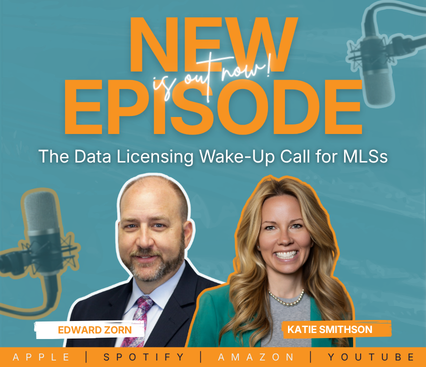
There is a lot happening behind the scenes in real estate right now, and most of it starts with data. has been digging into one of the biggest questions in real estate – what actually happens when a home is listed off the MLS instead of on it?
Who controls it, who uses it, and who actually benefits from it have become much bigger questions than they used to be.
Katie Smithson talks with Edward Zorn about a part of the business that usually stays in the background. What starts with data licensing quickly opens into a sharper discussion about ownership, protection, and why so many of the rules that still shape this space were built for a very different version of the internet.
Ed looks back at how the industry handled the early internet and how some of those assumptions completely missed the mark. “Not only was it wrong, but it was also the exact opposite of what actually happened.”
The conversation then moves on to how listing data is being used now, where the real risk lies, and why AI has raised the stakes even more. Ed is clear that the issue is no longer just access. “The theft now comes through the data feeds.” He also says, “The photographs are the holy grail of protecting the data.” From there, the episode turns to what MLS leaders need to do now, especially regarding ownership, rules, and protecting the value of the data.
Here are the key takeaways:
(5:25) Updating IDX rules for the AI era
(10:52) Cooperation, consumer harm, and old industry habits
(11:51) What better data stewardship actually looks like
(15:01) Copyright as a real answer to AI scraping
(19:48) How REcore helps protect broker content
(21:20) The MLS advantage in spotting data misuse
(24:50) What happens when a licensee breaks the rules
(29:31) Why old MLS licensing systems are falling behind
(33:50) A bigger data vision for brokers and vendors
(36:32) Modernize now or lose control of the data
If you like episodes that feel current, sharp, and a little more inside than expected, this one is worth your time. Tune in for a conversation about data that says a lot more.
About Edward Zorn
Edward Zorn is Vice President and General Counsel at California Regional MLS. He oversees legal matters across the business and supports company strategy and operations. He has worked in real estate law for more than 30 years and has also worked as a broker.
Connect with James
LinkedIn
About Katie Smithson
Katie Smithson is serving as CRO of REcore and is a long-time veteran of the real estate industry with a history of MLS relationship management and product innovation. In her most recent role, Katie was Chief Revenue Officer for California Regional MLS (CRMLS), directing revenue operations and ensuring proper communication and collaboration between all of CRMLS’s revenue-generating departments. In addition, she has also served as a NAR REACH mentor, board member for the Council of MLS with a CMLX 1 certification, and RESO Board Secretary.
Listen to Other Streaming Platforms




Episode Transcript
Katie Smithson 00:00
The IDX policy was created in 2000 obviously, that was kind of like the turning point of the internet.
Edward Zorn 00:08
I remember coming into the business and people talking about now listings going on to the internet and how that was going to destroy buyer agency.
Katie Smithson 00:17
Ai, is changing the game too, right? The way the data is displayed now, and the tools that are out there, data can be scraped and then, you know, AI can take that in and train on it.
Edward Zorn 00:29
We can look at the AI use and the risks of data bleeding into AI without that attribution and credit and monetization, going back to the brokers.
Katie Smithson 00:41
Welcome to REpod — the organized real estate podcast, for the industry, by the industry. This is where MLS leaders, association executives, and brokers come to rethink operations, simplify complexity, and build systems that actually work together. Join the REcore team as we challenge outdated processes, explore smarter technology, and have honest conversations about the future of real estate. Let’s get into it. Welcome to another episode of REpod with me. Your host, Katie Smithson, today we’re going to have a fun conversation. I think I’m excited for our guests. We want to talk a little bit about data, and I think for years, listing data in particular has been treated more of a as a marketing tool for agents and brokers. But in the era of AI, that same data is becoming an even more valuable asset, beyond just the players in the real estate industry. So what we want to talk a little bit about today and dive into is the big question, which is, who actually controls the data? So today I have a special guest, Mr. Ed Zorn. I’m sure all of our listeners are very familiar with Ed, but Ed is the VP and General Counsel for CRMLS. He is also sharing that same role for REcore, doing little dual roles here. So I want to welcome Ed. Ed, how are you doing today?
Edward Zorn 02:18
Doing great. I appreciate you saying that’s a fun conversation when you pull a lawyer and an MLS executive into the podcast, but that’ll be riveting and exciting.
Katie Smithson 02:28
Listen. We got to get everybody hyped up for this. And I don’t think you’re not, you’re you’re not the typical attorney. Ed, let’s just go ahead and call that what it is. You have some interesting thoughts. You are not afraid to share them. So I do think this is going to be a fun conversation.
Edward Zorn 02:45
It’s always fun when you and I get to have a conversation,
Katie Smithson 02:49
yeah, for sure. So I guess you know, just in case there’s anybody that’s not familiar with your background, I believe you’ve been at Sierra Lewis for 10 years. Is that right?
Edward Zorn 02:59
11 years in a couple of months. Yeah, and then before that time, of of working with with closely with art and the team at cmls, I represented a number of local realtor associations as well as brokerage firms. And I was actually, at that time, also a State Director for the California Association of Realtors and involved in a lot of committees at my kind of local level. I have experience in operating a you know, residential brokerage firm. I also managed a cold gold Banker Commercial Office spread out over three counties in Southern California. And then previous to that, I was actually a plaintiff’s litigation trial attorney, and so yes, I did sue realtors who did bad things, and I don’t apologize for that and others that hurt consumers. So I have some of that experience under my belt as well,
Katie Smithson 03:55
nice so I mean, just really running the gamut of all like you’ve touched pretty much every area of real estate, which I think is just, it’s very fascinating, even though, like I said, You’ve been at Sierra Lewis for almost 11 years. I mean, to me, I feel like you’ve been in this industry forever. So
Edward Zorn 04:15
my hairline,
Katie Smithson 04:18
yeah, for sure. So okay, so I want to talk a little bit. Let’s get into the history of we’ll start kind of going back to IDX, how that came about. I mean, obviously that was built for a different era. That was the IDX policy was created in 2000 obviously that was kind of like the turning point of the internet, when listing data really started getting out on a broader consumer level, and the goal was really to facilitate, broker cooperation. But I think over the years, obviously, that there hasn’t been a lot of change to that rule, and it has kind of UN. Intentionally cause some, I guess, maybe unforeseen uses of the data. So I guess, from your perspective, how did that IDX policy in 2000 What do you think needs to happen to bring it more up to present day, to address, you know, some of the things that are out there, like, particularly, AI,
Edward Zorn 05:25
yeah, it’s always interesting, because if you look at the MLS rule sets, even NAR policy, car model rules, we literally still have rules that are clearly written for books, right? And so it is time to long past time for for some kind of modernization of these processes. So for people who don’t know the history of IDX, is interesting, because I got my real estate license in 2002 so right as so I got my start in real estate, when these things were happening. And I remember when the first year when I started in real estate, with the internet and listings being displayed, realtor.com was by far the most dominant website. I believe 84 85% of people who went online went to realtor.com in that era. And what’s interesting is the statistics of how many times a buyer hired a buyer’s agent was also in the low. 80s when I started, was 82 83% of the time a buyer would hire a buyer’s agent. And I remember coming into the business and people talking about now listings going on to the internet, and how that was going to destroy buyer agency. Why would a buyer ever need to hire an agent? If they could just go on to online, look at all the pictures, get all the information, they’re never going to use an agent again. And what happens with most predictions in the real estate field, not only was it wrong, it was the exact opposite of what actually happened, right? I think last year we hit an all time high in buyer representation, meaning buyers hiring agents something like 95 96% of the time. So again, not not only did their predictions not happen, the exact opposite happened, and more people used buyer agents. And so I think there’s a lesson to be learned in that. But for those who don’t know how this sharing of listings online kind of came about, it had kind of a windy path, and as this new technology came out, right, NAR and through national policy was trying to kind of decide what to do. And interestingly enough, they had a policy and I L policy right, a policy where, as a broker, you could decide which cooperating brokers in the MLS system could receive your listings, and you could also say, I don’t want other companies to have my listings. And what a lot of people did back in those days is there’s a new fangled brokerage business coming out called Redfin that was doing everything online. And so people would say, Yeah, I’ll let my listings go to the local century 21 or Caldwell Banker agent, but I’m not going to let my listings go to that Redfin company and the way they do their business. And so in the very early days, guess who it was, Katie that went to the Department of Justice at the federal government and said, No, we need some regulation. We need some enforcement of the antitrust laws in this area, right? And so eventually, the Department of Justice sued the National Association of REALTORS because of this policy of allowing the brokers to choose and pick. I want listings to go to this company, but I don’t want my listings to go to that company. And eventually that resulted in a consent decree from 2008 and that’s what kind of locked the rules down for a 10 year period, because that was in the consent decree. So this is why you really didn’t see as the marketplace matured and the use of the internet changed, we were locked into this, this rule set that was drafted by NAR and the Department of Justice, and that’s where they set up the participant rules. And remember back in the early 2000 2005 what was our concern as an MLS? The concern was if, if somebody got access to the system, they could download the data and then go do whatever they wanted with it. So we had this gatekeeping of this participant rule at the top of the rule set. Now, as we sit here, you know, 20 plus years later, we’re not. Concerned at all that if I give somebody a login to use the front end systems that CRMLS, as an example, has not concerned
Katie Smithson 10:09
that any
Edward Zorn 10:10
is going to steal our data. Right? The theft now comes and the violation of the rights comes through the data feeds, and that is now where that needs to be managed. So again, this is a great example of where these rules of where these rules need to be updated. And we need more at how we deal with data feeds and who gets a data feed, rather than having these kind of, you know, 25 year old rules, kind of at the top of the rule set, saying who can or cannot join an MLS. So we’re kind of, you know, bracing now for this change to come, and it’s going to start coming fast, because, yeah, that consent decree expired in 2018
Katie Smithson 10:50
Yeah,
Edward Zorn 10:50
why did we not change these rules?
Katie Smithson 10:52
Right?
Edward Zorn 10:53
Right? It
Katie Smithson 10:54
well, and I feel like we could go on a whole other tangent about some of the other things that are happening in the industry now that it’s like almost hearkening back to those days of hiding listings from other brokerages,
Edward Zorn 11:07
the government, plaintiff lawyers. It was, it was the way business was done for decades.
Katie Smithson 11:17
Yeah. And
Edward Zorn 11:18
then to the, I mean, I wish I could say it was the credit of the real estate, organized real estate, we were forced to, you know, take better care of the customer. And so we developed these, these methods and systems of cooperation. And now I feel like, you know, under the guise of innovation, we’re going backwards 30 or 40 years, where people are very comfortable harming a consumer just so a broker can make more money. I thought we left that a few decades ago, but apparently, not apparently, we’ve got to redo this
Speaker 1 11:50
fight
Katie Smithson 11:51
again. Oh, you know, history repeats itself. Well, I mean, I think that also brings up the point of, like I said, I think AI is changing the game too, right? So it’s no longer just about the display of the data, but you know, you know, going back to what you were saying about protecting the data, and you know back in the day, people being able to download the data and having access to it without permission, but the way the data is displayed now, and the tools that are out there, data can be scraped, and then, you know, AI can take that in and train on it and do all of these things without any kind of attribution, without any really credit to the contributing, brokers and agents. So I guess, what can we do at the point we are now, what can we do to just be better stewards of that data, to protect the brokers, to protect the agents and and really the data compilation that the MLSs are providing out there. So I guess just what’s your take on how we can address this going forward, kind of in your perfect world, what can we do to make the data safer?
Edward Zorn 13:06
That’s a great question, and it’s kind of far reaching. I think we have a couple of tools available to us as an MLS, obviously, we have our licensing agreements, and we give permission for the data, and this is one of the foundational principles of our core solutions, right? We want lots of people to use the data. We want them to be innovative with the data. We want to allow any kind of conceivable use for the data that is helpful for not just the industry and the brokers, but the individual companies who are using the data to make money. That’s great. Our point is we want to make sure that that data is respected, that proper attribution and credit is giving to the listing brokers and their agents that contribute the contents of that information, that if there is money to be made off of that process, that that money goes back to the MLS for the work that they do in correlating, developing, transmitting that data, and that that money goes back to the brokers who actually employ the agents and operate the systems to go and put those contributions in right? So it’s good for people to use the data, it’s good for people to monetize the data, but that money needs to come back to the people who do the work, right, which is the brokers, right? Yeah. And so that is a very important process of what we’re trying to build in this this element. And here’s the other thing, for that to function, for that data to hold its value, it means we have to stop letting people steal it, right? Because when you have stolen goods in the marketplace, the people who make a legitimate product following the rules, their their their input is devalued.
Katie Smithson 14:53
Yeah,
Edward Zorn 14:54
right. And it just ordinary economics, right? Supply and demand and so I. I believe currently, with where we sit, we can look at the AI use and the risks of data bleeding into AI without that attribution and credit and monetization going back to the brokers, and we can borrow what other industries are doing in putting those guardrails and limits around AI. And what that is, is copyright law, right? You see this in the music industry. You see this with paintings and photography. Right? The copyright laws are very well defined. And one huge advantage you have with copyright law is there are statutory damages. What that means is they’re set by law, by code, that if somebody infringes on your work that has been registered in a copyright and they do so intentionally, then they have to pay a fine. You don’t have to prove damages, and that’s super important when we’re talking about people grabbing data and showing it somewhere else and all of that. Here’s the challenge we have in again, our 25 year old rule set that the way the NAR rule set works right now, we are forbidden as a multiple listing service from requiring the brokers from giving us an assignment, which means ownership rights over the content and the contribution that they put in the MLS that is held and still owned by the broker. And there were some really important and good reasons for that 25 years ago, but what has happened in the meantime Katie is brokers need to use the MLS data for more than just looking for what’s for sale, right? And you know this in your prior history in the business, right? I think you work for one of the best CMA companies that was out there. I’m pretty sure that doing a comparative market analysis, and being limited to only the listings that your own brokerage firm used, means that your CMA is going to suck, right? It’s not going to be worth anything. So because the brokerage community and the agents we serve need to use the cooperatives, right? Everybody’s listings to do CMAs, to do automated valuation models, to power back end services, to do statistical analysis. Right? Everybody is benefited by using everybody else’s listings. And so what that means as a as an MLS, what we are required to get legally is an extremely broad license, so that, as an MLS, these brokers are already giving us, and the photographers who take pictures are already giving us, a very broad license that gives the MLS the authority to move the data around, to create derivative works, to actually authorize its use in AI or machine learning right, and to give further rights downhill for whatever those products are to be licensed to others. So what that means, in a realistic standard is, if you’re a broker or a photographer, and you’ve given this broad license and you see the picture you’ve taken in some website or in some product, how will you ever know if that is infringing or not? You’ll never know.
Katie Smithson 18:38
Great, right? And that was, yeah, that was going to be kind of my next question is like, what you know? I know that obviously there’s some consternation over about brokers wanting to give over that that intellectual property ownership to the MLS, but on the flip side, what is the benefit there, and why does it make sense for them to actually do this. And I think that, I mean, I think one you can talk on a broader scale, but then I do want to bring it back into like, more specifically, how REcore has addressed that, and how it’s been beneficial to the brokers, particularly in the CRMLS market, because REcore is handling the data licensing for them. So again, just broadly what what is the benefit to Why should brokers be willing to give over that ownership to the MLS? Break time out if you’re ready to put AI to work for your staff and your membership, it’s time to check out navigator. REcore is the exclusive reseller of navigator by Lindy head to REcore.net, forward slash navigator to learn more. All right, back to the show.
Edward Zorn 19:50
So it has to do with the way the laws are functioning. And again, the ambulances can’t control this. So how the US copyright law works is only. The owner of the work or an exclusive licensee is permitted to maintain a copyright case against an infringement. Now, the MLS never is going to want an exclusive license, because as the MLS, we acknowledge and we want the photographers and the brokers and the individual agents to be able to use their photographs and their property descriptions and all of the other information they contribute to the MLS. We want you to put that everywhere and do anything you want with it, so we’re never going to demand an exclusive license. Well, that means we’re not allowed, as the MLS to maintain a copyright case, to protect those individual elements. And let’s talk be real specific. Here it’s the photographs, guys, the photographs are the holy grail of protecting the data, right? And the reality is, if the MLS does not own the photograph, which is provided through an assignment, and only gets a license the MLS is handcuffed. We cannot protect those photographs and that data in the fullest method possible. So what I advocate assignment?
Katie Smithson 21:20
Sorry, yeah, no, I was just going to go back to your example of like, if I see if I’m a listing agent, and I see my my photographs, my listings out on some website or something, how can I prove that that is being used without my permission or without proper permission? And I think going back to what you’re saying is that that’s where the MLS comes in, and having that, that protection, it can actually be to the benefit of those, those brokers and the listing agents, because you do have this broader view into like, where the data is supposed to go, and if it is being displayed somewhere that it’s not supposed to be, then you can go After those bad actors,
Edward Zorn 22:01
right? Exactly We know and you don’t. So the only way you as a broker would know is you’d have to contact the MLS and go, Okay, I saw my photograph on this location. Is that permitted, right? And then you’d have to go, oh, by the way, to properly protect the data, Katie, you need to do copyright filings with the US Copyright Office every quarter for all of your content. And then, if you saw in a spot it didn’t belong, you would have to do a DMCA takedown notice, and then you would have to hire a lawyer to go after those, those infringements. Now we’ve had this system for 20 plus years, and I’m not aware of a single case of someone going through and filing that copyright claim right at a broker level. I’ve seen some photographers that have done it, you know, protecting some interests where they they did not provide the appropriate licenses to MLSs, right? That’s a different issue, but very, very limited. What I would advocate is, if the assignments would go to the MLSs, then you would finally give the MLS. Is that last piece of authority to go and manage this process, to watch over where the data is going. It is much easier. I have a compliance department. I have a full time person who looks at these things and tries to find these issues. Now I would finally be able to do something about it, you know. And we’ve had it. We had a recent case, right again, in REcores processes of helping CRMLS and helping them manage some of their rules and their processes, one of the benefits that CRMLS has is we have been operating a photography program, and in that Photography Program, approximately 30% of the professional photographers have actually assigned the ownership of those photos to CRMLS, and so we were recently able to use that fact that CRMLS is the owner of the property. We saw an alleged issue. We went down this copyright enforcement process, and we were able to get a resolution very quickly. It turned into an amicable relationship with the with the Violator, and things were made right and even leveraged into some positive opportunities, all because we owned as the MLS a certain number of photographs, and what we’re going to be doing is rewarding those photographers right when the time comes to thank them for trusting us with that data, you know? And so it was a very interesting learning experience, because here’s the challenge, Katie, most MLS have. It is you authorize the use of the data and the MLS data for something legitimate, as an example, you know, a CMA product, or a broker back office product.
Katie Smithson 25:12
And
Edward Zorn 25:12
then also, now you’ve got, in CR Melissa’s case, we have 1000s of agents and hundreds of brokers using this legitimate product proper use. But then if that technology company, whoever the licensee is of that then takes our data and goes sells it on a secondary market, or packages it up with some other MLS data and and moves it and does something they’re not supposed to do with it, what are the rights we have as an MLS or we as REcore in running that license department? So here are the challenges. Right I can call breach and turn the data off,
Katie Smithson 25:56
yeah, how
Edward Zorn 25:56
happy Katie, do you think I’m going to have with 500 brokers and a couple of 1000 agents when I just turned off their websites, their back office and all of their CMAs. Do you think maybe we would get a little bit of a phone call?
Katie Smithson 26:13
I think your phones will be blowing up.
Edward Zorn 26:18
I think that’s exactly what happened. And then what my other challenge would be? Okay? So then do I file a breach of contract lawsuit, and now I have to somehow try to prove up damages? Well, what are my damages? Right? That becomes very costly, very hard to do. And here’s the thing, Katie, these companies who are stealing the brokers information. They know exactly what they’re doing, and they know that an MLS is not going to shut them off because they have, they’re providing a legitimate product for the membership,
Katie Smithson 26:52
and they know it’ll cause issues for the membership and the MLS. And so it’s yeah, it’s
Edward Zorn 26:59
so they
Katie Smithson 27:00
basically, they’re just, yeah, they’re doing what, whatever they can, and they get away with it until somebody calls them on it,
Edward Zorn 27:07
right? So now imagine, though, if the MLS was the owner of the photos. I don’t have to turn them off. Katie REcore doesn’t have to flip the switch and turn off the flow of data for these legitimate uses. What Ari court can do instead, or the MLS can do if the depending on how the ownership structure gets passed along, is do a a, you know, cease and desist, a takedown notice and a demand for a violation and an infringement of copywriting these let’s just use the photos as an example. Once this case, we have an average of 33 photographs a listing at any given moment. Katie CRM less has 25,000 active listings. So if we owned all right, dude, it’s simply 33 times 25,000 Yeah, and Katie, the minimum statutory fine for an intentional infringement is $750 a photo. We are talking about demands in the hundreds of millions of dollars range.
Katie Smithson 28:35
Yeah,
Edward Zorn 28:35
I’m pretty sure if someone is selling our data for 50 100 $200,000 and we send them a demand, I don’t know, for 250 million, maybe they would stop stealing our data. Yeah, and so use to then have them come and again, if there’s a legitimate use, we want to have them use the data in a good way, but they need to pay for it. They need to make sure that that money gets back into the hands of the MLSs and the brokers who are providing the data in the first place.
Katie Smithson 29:13
Yep, which is, I think, a great opportunity for would just love for you to talk a little bit more about what we are offering at ra core from the data licensing perspective, and how that addresses all of these pain points that you have just brought up.
Edward Zorn 29:31
Yeah, so I think hopefully the audience can kind of appreciate the fact that, you know, operating a licensing system through CRMLS, and the size that we are is brought a lot of information and and knowledge and experience into our team, which is now with REcore, and it is based on those experiences that we’ve devised a licensing program, because we totally understand that. That when you’re running an MLS, there’s lots of things to do, there’s lots of things to handle, and sometimes the licensing is, hey, we have this set of old, ancient, 20 year old rules. We’ll just kick this out the door with some kind of vendor, you know, who just kind of manages the data, will slap some minimal pricing on some things that cover some costs, and call it a day, right? And then those systems have been placed for 20 years. And so what REcore has offered is let us come in like a full featured package. I think that the easiest and the first layer is we have uses of the MLS data for which the old rules, the vow rules, the IDX rules, have absolutely no accommodation for right and and so we’ve developed processes, recommended rule changes, licensing terms to modernize the use of the data so that it goes to people to be used well, but people who make money off of your data pay money, and people who use the data to support the MLS is network effect. In other words, they support representing buyers, they support representing sellers, and as a result, that helps the MLS in the network effect and the services that they provide that is a a very low or free cost structure compared to entities who don’t represent buyers, they don’t represent sellers. They’re just making a bunch of money off of the work you do as a broker, right? Those people need to pay for the services that they’re getting from the data, right? And so we have programs in place. We have relationships and licensing agreements in place to help manage that process for MLSs, and this is great, you know, again, if you’re a giant MLS, like, like, like, CRMLS, they still use our services, right? Yeah, you still get the benefit of that, that level of experience of big professional use. But think of how great that is if you’re a small or a medium MLS, and you don’t have the resources available right in house general counsel to negotiate these things and develop these processes and modify these rules, right? So that’s where REcore can kind of we saw this niche of this need in the industry to modernize how the data flows and how this licensing works, and so that’s what we can now offer, you know, as a service
Katie Smithson 32:48
well. And it’s not just to the benefit of the MLS is either. It’s to the benefit of those data consumers as well. Going back to your point of, you know, ending up with a lawsuit on on your desk like nobody wants that. Nobody wants to have to deal with that. So this is really about making sure that the data is again protected, but the contributing brokers and agents who have put this data into the MLS are being properly compensated for that use the MLS is protecting that data, and the end users are ultimately being good partners, because they have all the proper permissions in place they can, like you said, that we’re building into the rule set of the licensing the proper uses of that data. So if they want to use AI, then they’re, you know, they have that permission
Edward Zorn 33:42
absolutely
Katie Smithson 33:42
and they’re not going to end up in in trouble or the threat of having the the feed cut off and and making everybody angry. So
Edward Zorn 33:51
there’s another huge benefit for the vendor community, and that is, you know, we have a vision as this grows, that they imagine these vendors getting one set of licensing rules. Imagine them getting one set of display standards, right, so they don’t have to build to 500 different MLS rule sets,
Katie Smithson 34:15
right? Or 500
Edward Zorn 34:16
mls, you know, licensing requirements, right? You know, we also have a vision through the RA core rule set and what these licensing, you know, parameters are as again, as this grows, you know, why should the display be limited only to the borders of a particular MLS, right? Why? If I’m, you know, with data shares and CRMs, again, has led the way in some of this with some of our data share partners, and sharing Southern California data, you know, around the country, you know, into areas, into the south and into the northeast, right? Because people move right. Why can’t there be a data feed with the permissions in it, so that if you’re going. Get an IDX display or use the data. You get all of the data that’s in the all of the MLS customers and RA course services, right? How helpful is that to a larger broker, a larger regional or a national broker, that they can engage with their local MLS, and that data feed then has that bigger bucket with more information in it, right? So again, the whole design of what REcore is doing on the licensing side is to help MLSs, right? To help manage that in a very professional, well thought out program to help the vendors and the licensees. So there’s a single set of display standards that’s well known that you can build against with AI usage, right? And then help the brokers so that they could get access to a superior data feed that has lots of data in it with, again, the proper rules and cooperative structures around it, right? So it’s really a thoughtful concept that is really designed to move us into what’s next, not just solving an immediate problem for right now.
Katie Smithson 36:05
Yep, totally, I love this. I mean, I think this has been a very exciting and fun conversation. I guess, final thoughts if, if there are MLS leaders out there listening to this, hopefully they are and have not really thought about their data in this way, kind of, what would your parting advice be? What questions should they be asking? And ultimately, how can we help?
Edward Zorn 36:32
I think the first thing you have to start thinking about is modernizing your rule set right for mid 2020s and not have a rule set that was designed for in 2005 that’s number one. And again, our core has a consulting arm that we can come in and help do that analysis and and manage what that is. Second of all, it is to protect your data, right? You need to have those conversations with your brokerage community, right about who owns the content, so that there can be some strategy developed on, how are you as an MLS, going to protect your data from people who are stealing it from you, and what are you doing about it? And then third, right, how can you then solve the problems in the industry of making sure the data is accessible. It’s usable by your membership, by the brokers, by the vendor community, by the advertising community, right? And that those rules and those systems are in place, again, modernized for how data is used in our era. And moving forward, what are you going to do about artificial intelligence? And if
Katie Smithson 37:45
some
Edward Zorn 37:45
company, some giant, trillion dollar company, goes out there and just scrapes the photos off of some website, and what are you gonna do about it? Then at that point, Katie, it’s too late. The horse is out of the barn. It’s not going back in right so you need to act right now to implement these strategies and to do something right, to protect what you’ve built over these decades.
Katie Smithson 38:10
Awesome. Well, thank you so much for your time today. Ed, I think this has been a really great conversation. I also don’t think this will be the last time we hear about this topic. Well, looking forward to more exciting conversations, and yeah, tune in next time to see what else we’re going to talk about. So thank you again, Ed, this has been great, and
Edward Zorn 38:36
Thanks Katie,
Katie Smithson 38:38
That wraps up this episode of REpod. If this conversation made you think differently, don’t keep it to yourself. Subscribe, share it with your network, and sign up for our newsletter to stay in the conversation. The future of organized real estate gets better when leaders engage.